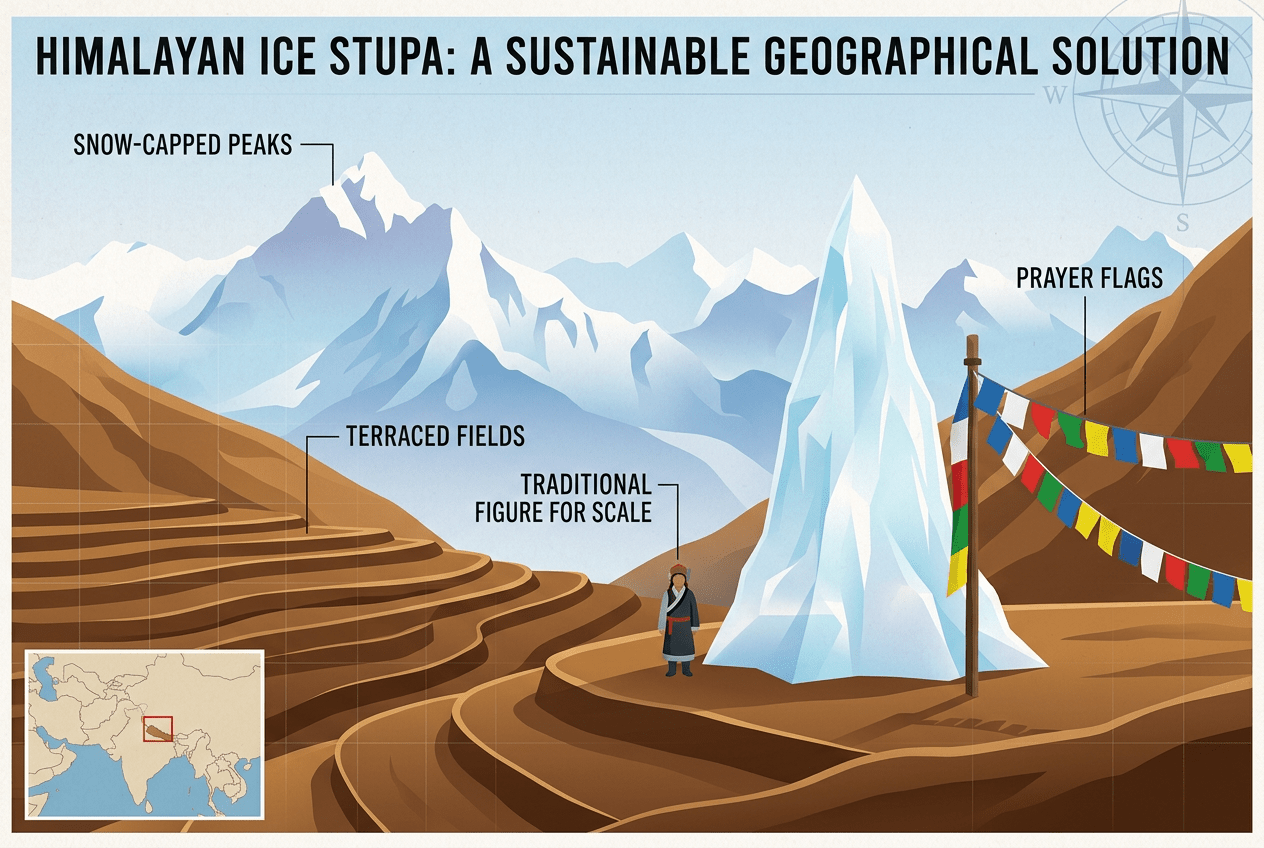
High on the Tibetan Plateau’s western edge, in a landscape so arid it receives less rainfall than parts of the Sahara, farmers face a cruel paradox. Water is everywhere in Ladakh — locked in glaciers crowning the Karakoram and Himalayan ranges — yet in April, when barley and apricot orchards desperately need irrigation, the streams run nearly dry. The glaciers that feed them don’t begin melting in earnest until June. For centuries, this seasonal mismatch defined the limits of agriculture in one of the world’s highest inhabited regions. Now, a remarkable piece of vernacular engineering is rewriting those limits: the ice stupa, an artificial glacier that stores winter water as a towering cone of ice and releases it exactly when farmers need it most.
The Geography of a Cold Desert
Ladakh, a high-altitude region in the Indian union territory bordering Tibet, sits in the rain shadow of the Great Himalayas. Monsoon clouds sweeping north from the Indian Ocean drop their moisture on the southern slopes, leaving Ladakh with a scant 100 millimeters of annual precipitation. Villages like Phyang, Nang, and the regional capital Leh perch at elevations between 3,000 and 4,000 meters, where winter temperatures plunge below -20°C and the growing season lasts barely five months.
Agriculture here has always depended entirely on glacial meltwater, channeled through an intricate network of traditional canals called yuras. Communities historically appointed a churpon, or water master, to allocate every precious liter. This system worked for a millennium — until the glaciers themselves began to retreat.
Vanishing Glaciers, Shifting Seasons
The Hindu Kush Himalaya region, often called the “Third Pole” because it holds more frozen water than anywhere outside the Arctic and Antarctic, is warming faster than the global average. Studies suggest that even if global temperatures stabilize at 1.5°C above pre-industrial levels, the region could lose a third of its glacial ice by 2100. In Ladakh, smaller, lower-altitude glaciers — the ones closest to villages — are disappearing first.
The consequences are twofold. Total meltwater is declining, and its timing is becoming more erratic. Spring sowing, the linchpin of Ladakhi agriculture, is precisely when the shortage bites hardest. Some villages have already been abandoned for want of water, their residents becoming some of the world’s first climate migrants.
From Horizontal Ice to Vertical Towers
The idea of storing winter water as ice isn’t new to Ladakh. In the 1980s and 90s, a civil engineer named Chewang Norphel — later dubbed the “Ice Man of India” — built horizontal artificial glaciers by diverting streams into shaded, walled fields at high altitude, where the water froze in thin layers. Norphel built more than a dozen of these, some storing millions of liters. But they had a limitation: they had to be constructed at elevations above 4,000 meters, far from villages, to stay shaded and cold enough.
In 2013, Sonam Wangchuk — an engineer and education reformer whose life loosely inspired a famous Bollywood character — had a geometric insight. A vertical cone of ice exposes far less surface area to sunlight than a flat sheet of the same volume. If you could freeze water into a tall cone, it would survive well into late spring even at lower, warmer altitudes right beside the villages that needed it.
How an Ice Stupa Works
The elegance of the ice stupa lies in its simplicity. No pumps, no electricity, no moving parts — just gravity and physics:
- Gravity-fed pipeline: A pipe carries water from a stream at higher elevation down to the village. Because the intake sits perhaps 60 meters above the outlet, natural pressure builds in the pipe.
- Vertical fountain: At the site, the pipe turns upward and sprays water into the frigid night air through a sprinkler head.
- Freezing on contact: In winter temperatures of -15°C to -30°C, the droplets freeze as they fall, accreting layer by layer around a scaffold of branches and netting.
- The cone takes shape: Over weeks, a conical tower rises — some exceeding 30 meters, storing millions of liters of ice.
The conical form, echoing the Buddhist stupas that dot Ladakh’s landscape, minimizes the surface exposed to the intense high-altitude sun. When spring arrives, the stupa melts gradually from the outside in, releasing a steady trickle into irrigation channels through April and May — precisely bridging the gap until the natural glaciers awaken in June.
Phyang and Beyond: Stupas in Action
The first prototype, built near Leh in the winter of 2013–14, stored about 150,000 liters and survived until mid-May despite standing at just 3,170 meters. The proof of concept attracted crowdfunding, and in 2015 a full-scale stupa rose at Phyang village, storing nearly two million liters and irrigating newly planted poplar and willow saplings on previously barren desert land.
The idea spread rapidly. Villages across Ladakh — Gya, Igoo, Shara, Takmachik — now build their own stupas each winter, often as community competitions with prizes for the tallest tower. The technique has crossed borders too: engineers have adapted ice stupas in the Swiss Alps (in Pontresina, partly as a tourist attraction), in Chile’s mountains, and in Gilgit-Baltistan in northern Pakistan, where similar cold-desert conditions prevail. Wangchuk’s work earned him the Rolex Award for Enterprise in 2016.
Limits and Honest Caveats
Ice stupas are a brilliant adaptation, but they are not a cure for glacier loss. Several caveats matter:
- They store, they don’t create: Stupas redistribute existing streamflow across seasons. If upstream glaciers vanish entirely, there will be no winter water to freeze.
- Efficiency losses: Research suggests a significant fraction of the sprayed water is lost to evaporation, wind drift, and runoff before freezing — figures vary, but losses can exceed two-thirds in poor conditions.
- Maintenance demands: Pipes freeze and burst, sprinklers clog with ice, and volunteers must tend the systems through brutal Himalayan winters.
- Downstream questions: Diverting winter flow may affect ecosystems or communities farther down the watershed, a concern geographers of water governance take seriously.
Warming winters pose a longer-term threat: ice stupas need sustained sub-zero nights to grow, and Ladakh’s winters are gradually softening.
A Lesson in Vernacular Climate Engineering
What makes the ice stupa story so compelling for geographers is how thoroughly it is a product of place. It marries physical geography — aridity, altitude, extreme diurnal temperature swings, glacial hydrology — with human geography: Buddhist cultural forms, communal water governance, and the ingenuity of local engineers responding to a global crisis with local materials.
In an era when “climate engineering” often evokes billion-dollar geoengineering schemes, Ladakh’s ice towers offer a humbler model: adaptation designed by the people who live with the problem, built with pipes, gravity, and cold air. They may not save the Himalayan glaciers, but they are buying time — one frozen cone, one spring harvest, one village at a time. And in the high desert, time measured in weeks of meltwater can mean the difference between a community that endures and one that empties.