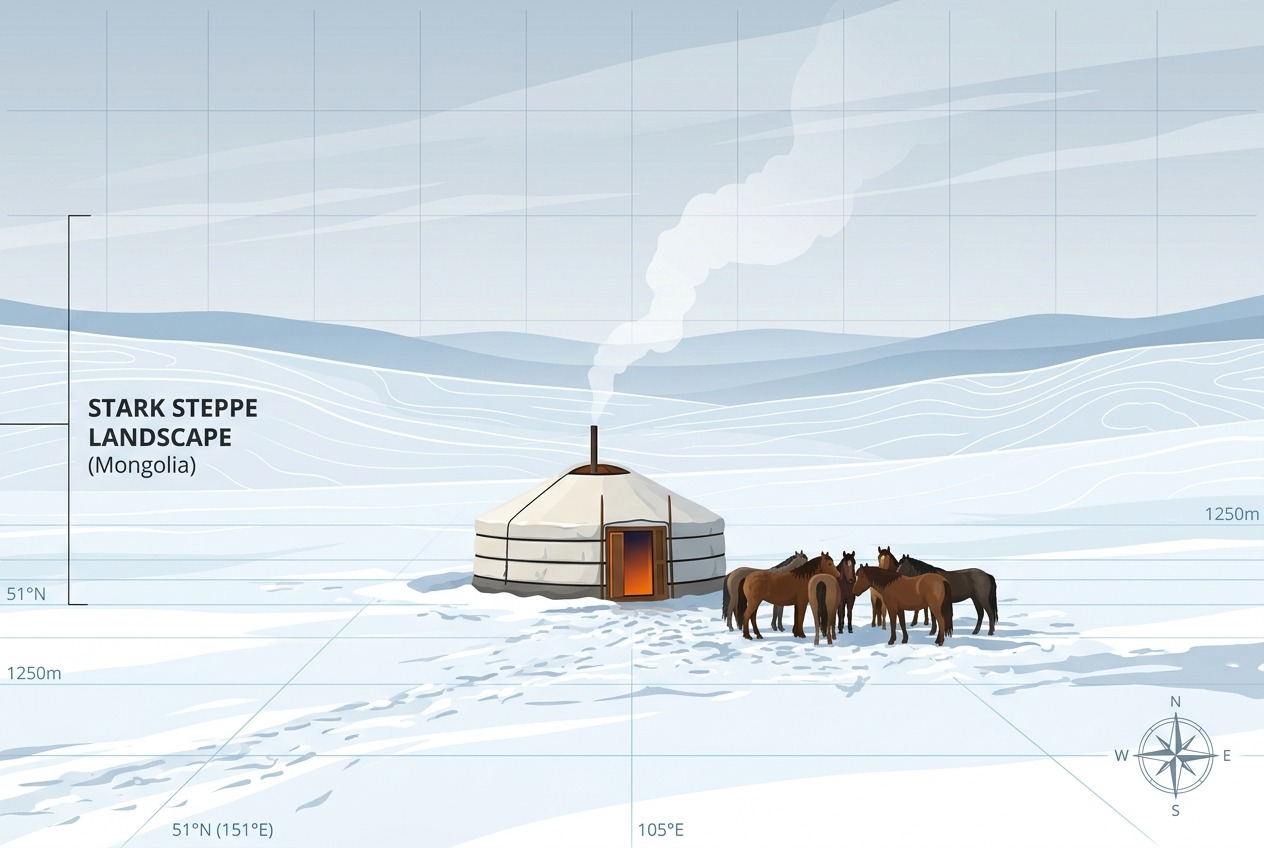
What Exactly Is a Zud?
A zud is best understood as a compound disaster: a one-two punch of climatic extremes. The first blow lands in summer, when drought withers the steppe grasses that livestock depend on. Animals enter the cold season underweight, with insufficient fat reserves. Herders, meanwhile, are unable to cut and store enough hay for winter feeding.
The second blow arrives with winter itself. Mongolia sits at the heart of the Eurasian landmass, far from any moderating ocean influence — a textbook example of an extreme continental climate. Winters are dominated by the Siberian High, a massive dome of cold, dense air that parks itself over the region and drives temperatures to some of the lowest recorded outside the polar regions. When an unusually harsh winter follows a drought summer, livestock simply cannot survive. They starve, freeze, or both.
Mongolian herders actually distinguish between several types of zud, each with its own deadly mechanics:
- White zud (tsagaan zud): Heavy snowfall buries pasture so deeply that animals cannot dig down to graze.
- Black zud (khar zud): A paradoxical lack of snow means livestock have no snow to eat for water in a landscape where wells may be frozen or absent.
- Iron zud (tömör zud): A brief thaw followed by refreezing coats the ground in an impenetrable crust of ice, locking grass away as if behind armor.
- Cold zud (khüiten zud): Sustained, extreme cold forces animals to burn energy faster than they can replace it, even when forage is technically available.
- Hoof zud (tuurain zud): Overgrazing concentrates too many animals on limited pasture, trampling and exhausting it before winter’s end.
The Geography Behind the Disaster
Mongolia’s physical geography makes it uniquely vulnerable. The country is a vast, elevated plateau — averaging around 1,580 meters above sea level — sandwiched between Siberia to the north and the Gobi Desert to the south. Roughly 80% of its territory is grassland steppe, one of the largest intact grassland ecosystems on Earth. Annual precipitation is meager, ranging from about 400mm in the northern mountains to less than 100mm in the Gobi, and it falls mostly in a short summer window.
This means the entire pastoral economy depends on a narrow seasonal margin: enough summer rain to grow grass, and a winter mild enough for animals to reach it. Climate change is squeezing that margin from both ends. Mongolia has warmed by more than 2°C since 1940 — well above the global average — intensifying droughts, while winter weather has become more erratic. Scientists have noted that zuds, once expected roughly once a decade, are striking with increasing frequency.
Counting the Losses: Zuds in Recent History
The numbers involved in a severe zud are staggering. Mongolia’s national herd numbers over 60 million animals — sheep, goats, cattle, horses, and camels — in a country of just 3.4 million people. When a zud strikes, losses are measured in the millions:
- 1999–2002: Three consecutive zud years killed roughly 11 million animals and devastated herding households across the country.
- 2009–2010: One of the worst zuds on record wiped out approximately 10 million livestock — more than 20% of the national herd — in a single winter. Around 9,000 herding families lost their entire herds.
- 2023–2024: A catastrophic white and iron zud combination killed over 7 million animals, with snow covering up to 90% of the country at the disaster’s peak.
For a herding family, livestock are not just income — they are savings account, food supply, transportation, and social status rolled into one. Losing a herd means losing everything.
From Steppe to City: The Great Migration to Ulaanbaatar
Here is where the zud transforms from a rural climate story into an urban human geography story. When herders lose their animals, most have only one option: migrate to the capital, Ulaanbaatar, in search of wage work.
The result has been one of the most dramatic rural-to-urban migrations in Asia. Ulaanbaatar now holds nearly half of Mongolia’s entire population — around 1.6 million people — in a city originally planned for a fraction of that number. Successive zuds have acted as demographic pumps, each disaster pushing tens of thousands of climate refugees toward the capital.
The Ger Districts
Most migrants settle in the sprawling ger districts that ring the city’s northern hills. Named for the traditional felt tent (known elsewhere as a yurt) that many residents still live in, these informal settlements now house over 800,000 people — more than half of Ulaanbaatar’s population. Families typically fence off a small plot of land, pitch their ger or build a simple house, and begin urban life with few of its amenities.
The ger districts face severe challenges:
- No central heating or piped water: Residents haul water from kiosks and burn raw coal in household stoves through winters that regularly hit -30°C.
- Catastrophic air pollution: The combination of coal smoke, a valley location that traps air, and winter temperature inversions has made Ulaanbaatar one of the most polluted capitals on Earth, with winter particulate levels sometimes exceeding WHO guidelines by more than twenty times.
- Economic precarity: Former herders arrive with skills honed for the steppe, not the city, and many struggle to find stable employment.
In a bitter irony, families fleeing a climate disaster on the steppe often end up breathing some of the world’s most dangerous air in the city.
Adapting to an Uncertain Future
Mongolia is not standing still. Responses to the zud threat operate at multiple scales. Index-based livestock insurance, pioneered with World Bank support, pays out to herders when regional animal mortality crosses a threshold, providing a financial cushion. Early warning systems now combine satellite monitoring of pasture conditions with traditional herder knowledge. Government and NGO programs promote hay and fodder storage, veterinary care, and better herd management to reduce overgrazing — a growing problem as herders, chasing cashmere profits, have expanded goat numbers dramatically.
In Ulaanbaatar, efforts to replace raw coal with refined briquettes, extend infrastructure into ger districts, and develop satellite towns aim to ease the urban pressure. Progress is real but uneven.
A Warning Written in Snow and Ice
The zud is more than a Mongolian curiosity. It is a vivid case study in how physical geography, climate change, and human systems intertwine — how a drought on a remote steppe can, within a year or two, reshape the skyline and air quality of a capital city a thousand kilometers away. As the planet warms and climate extremes intensify, Mongolia’s experience offers the world a preview of climate-driven migration in action. The steppe’s ancient rhythm of grass, herd, and season is faltering, and millions of lives — human and animal alike — hang in the balance.