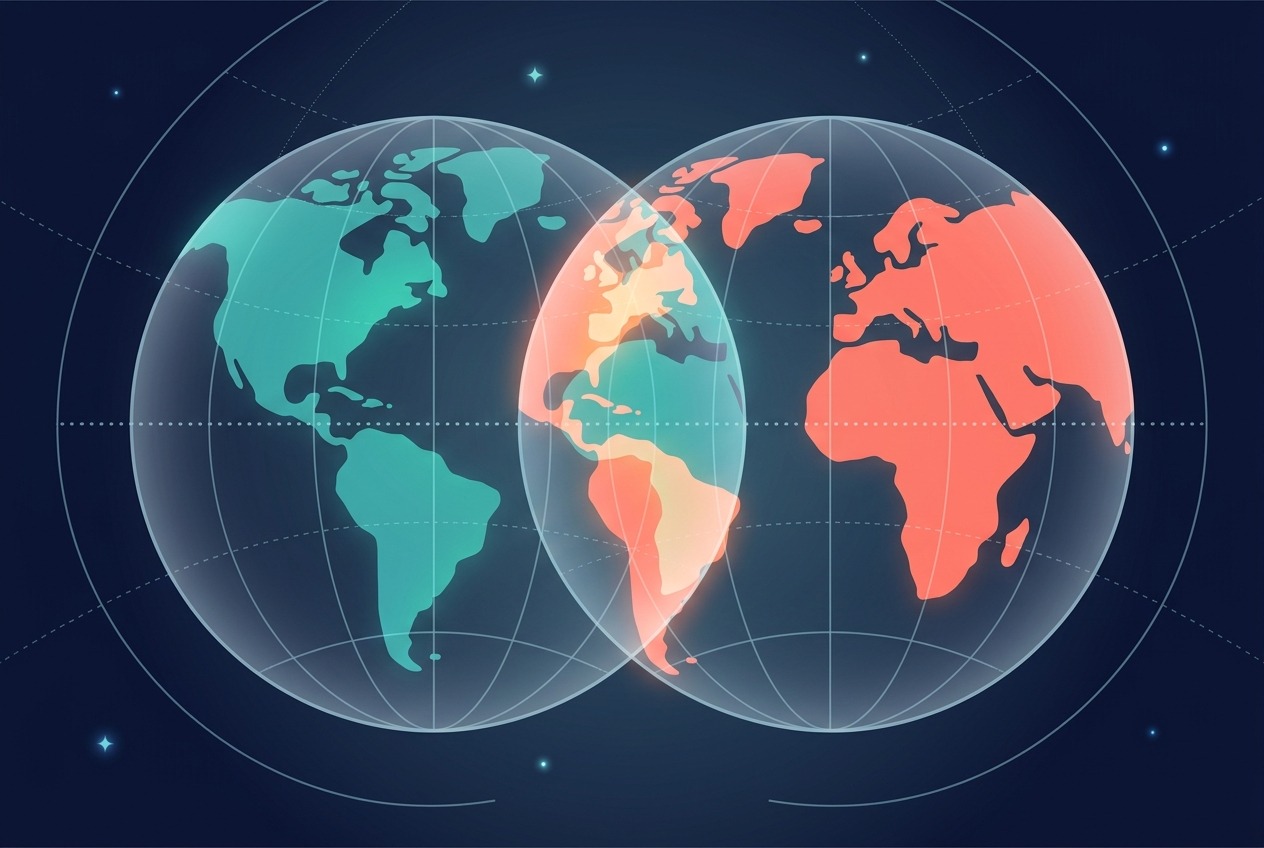
As a child, you may have been told that if you dug a hole straight through the Earth, you’d come out in China. It’s a charming idea — and, for most people reading this, completely wrong. If you started digging in New York, London, or Sydney, you wouldn’t emerge in China at all. In fact, you almost certainly wouldn’t emerge on land. You’d surface, dripping and disappointed, somewhere in the open ocean.
Welcome to the strange world of antipodes — the points on Earth’s surface that lie diametrically opposite one another. Understanding them reveals one of geography’s most overlooked facts: our planet’s landmasses are astonishingly lopsided.
What Exactly Is an Antipode?
The antipode of any location is the point you’d reach by drawing a straight line through the Earth’s center and out the other side. The word comes from the Greek antipodes, meaning “opposite feet” — a wonderfully literal image of people on the far side of the globe standing sole-to-sole with you through 12,742 kilometers of rock and molten iron.
Calculating an antipode is simple. Take your latitude and flip the hemisphere: 40°N becomes 40°S. Then take your longitude, subtract it from 180°, and switch east for west. London, at roughly 51.5°N, 0°W, has its antipode at 51.5°S, 180° — a patch of cold Pacific Ocean southeast of New Zealand, near the aptly named Antipodes Islands.
Antipodal points share some curious properties. They experience opposite seasons, and when it’s solar noon at one, it’s roughly midnight at the other. Sunrise at your location coincides approximately with sunset at your antipode. They are, in every sense, geographic mirror images.
The Great Antipodal Disappointment
Here’s the statistic that surprises almost everyone: only about 15% of Earth’s land is antipodal to other land. The rest — roughly 85% — sits opposite open ocean.
Why? Because the Earth’s surface is dominated by water (about 71%), and the continents are distributed with remarkable asymmetry. The vast Pacific Ocean, which covers nearly a third of the planet, happens to sit opposite Africa, Europe, and much of Asia — meaning almost the entire “Old World” is antipodal to water. Consider the roll call of misses:
- North America lies almost entirely opposite the Indian Ocean, with only slivers of Canada’s Arctic matching parts of Antarctica.
- Europe — nearly all of it — is antipodal to the South Pacific. Paris, Berlin, Rome, and Moscow all correspond to open water.
- Australia, despite its size, is opposite the North Atlantic. Dig down from Perth and you’d surface near Bermuda’s latitude, far from any shore.
- Africa is largely opposite the central Pacific, one of the emptiest stretches of ocean on the planet.
The “dig to China” myth, incidentally, works only if you start in parts of Argentina or Chile. China’s true antipodes lie in South America — which explains why Spanish speakers have their own version of the myth, in which children dig through to China quite correctly.
The Rare Antipodal Pairs
The small fraction of land that does align creates some fascinating pairings. The most famous is Spain and New Zealand. Much of the Iberian Peninsula sits nearly opposite New Zealand’s North and South Islands. Madrid’s antipode falls close to Wellington’s latitude, and the town of Hamilton, New Zealand, is roughly opposite Córdoba, Spain. It’s a poetic coincidence that two nations famous for wine, dramatic coastlines, and passionate rugby cultures should be planetary mirror images.
Other notable antipodal pairs include:
- Southeast Asia and South America: Much of Indonesia, Malaysia, and the Philippines lies opposite Colombia, Ecuador, Peru, and Brazil. Manila is nearly antipodal to Cuiabá, Brazil; Jakarta corresponds to a point near Bogotá.
- China and Argentina/Chile: Beijing’s antipode falls near Bahía Blanca, Argentina. Shanghai pairs approximately with Salto, Uruguay.
- Hawaii and Botswana: The Hawaiian islands sit roughly opposite the Okavango region of southern Africa — one of the few places where mid-ocean islands find land on the other side.
- Antarctica and the Arctic: Portions of the frozen continent align with Arctic coastlines of Canada, Greenland, and Russia — ice opposite ice.
Among true antipodal cities, a handful stand out. Christchurch, New Zealand and A Coruña, Spain are almost exact opposites. Whangarei, New Zealand and Tangier, Morocco form another near-perfect pair. And in one of geography’s neatest tricks, Ulan-Ude in Siberia is roughly antipodal to Puerto Natales in Chilean Patagonia — connecting two of the world’s most remote frontier regions.
Why Is the Earth So Lopsided?
The land-ocean asymmetry isn’t random chance frozen forever — it’s a snapshot of plate tectonics in motion. Around 300 million years ago, nearly all land was fused into the supercontinent Pangaea, surrounded by a single world ocean, Panthalassa. As Pangaea fragmented, the continents drifted apart, but they never spread evenly. The Pacific is essentially the shrinking remnant of Panthalassa, still vast enough to swallow every continent’s antipode on the opposite hemisphere.
Geographers sometimes describe Earth as having a “land hemisphere” and a “water hemisphere.” Centered near Nantes, France, the land hemisphere contains about 80% of all land. Its opposite, centered near New Zealand, is almost entirely ocean. This uneven split is precisely why antipodal land matches are so rare — and it’s temporary. In another 100 million years, continental drift will have redrawn the map entirely, creating new antipodal pairs and destroying today’s.
What Antipode Maps Teach Us
An antipode map — which overlays the world with its mirror image — is more than a curiosity. It’s a striking visual lesson in how we misperceive our planet. Standard maps, with their familiar continents, make land feel dominant. An antipode map corrects that illusion instantly: nearly everywhere you look, land floats on an overwhelming expanse of blue.
These maps also puncture our mental geography. Most people, asked what’s opposite their home, guess wildly wrong — usually naming a famous distant country rather than the anonymous stretch of ocean that’s actually there. Antipodes remind us that human intuition about the globe is shaped by flat maps, national borders, and cultural stories rather than by the sphere itself.
Standing Sole-to-Sole
The next time you’re standing on a beach in Lisbon, remember that a New Zealander near Auckland may be standing almost directly beneath your feet, separated by the entire diameter of the planet. For the rest of us, our planetary opposite is a lonely swell of seawater, rolling under a sky where our midnight is its noon.
It’s a humbling thought — and a perfect illustration of why geography still has the power to surprise. The other side of the world isn’t where the myths told us. It’s stranger, wetter, and far more interesting.